Threaders Show Their Pluck in Arizona Legal Challenge

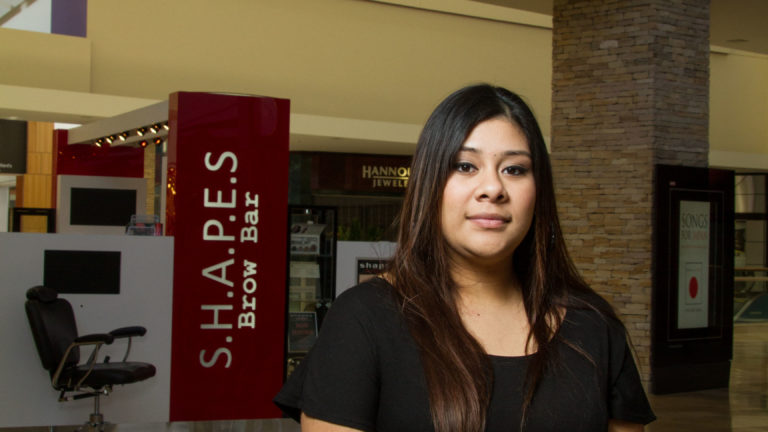
Juana Gutierrez works hard shaping the eyebrows of her clients as a means to support herself and her new baby. She works so hard, in fact, that she was back at work only a week after giving birth, working eight hour shifts and managing six different eyebrow “threading” kiosks in the Phoenix area. Juana is not looking for a government handout. She just wants the government to get out of her way so that she can pursue her own livelihood.
Eyebrow threading is a natural and safe method of hair removal that uses a single strand of cotton thread, wound tightly between the threader’s hands to form a loop that is then brushed along the customer’s skin to remove unwanted hair, most commonly from around the customer’s eyebrows. Threaders do not use any chemicals, dyes, hot wax or sharp objects. Threading is a centuries-old practice that originated in the Middle East and Asia but that is growing in popularity in the United States.
Threading is cheaper, faster and cleaner than the chemical and wax-based hair removal techniques taught in American cosmetology schools and practiced by state-licensed cosmetologists. It therefore creates vibrant competition with the members of the cosmetology cartel while expanding customer choice and keeping the price of beauty services low.
Of course, cartels hate competition. And when the cartel has the coercive power of the government at its disposal, it will often erect government-enforced regulatory barriers to keep out that competition. That is what is happening in Arizona, and that is why the IJ Arizona Chapter has filed its most recent lawsuit.
Despite the benefits of threading to entrepreneurs, workers and consumers, the Arizona Board of Cosmetology declared that all threaders must be government-licensed aestheticians or cosmetologists—and that they must work in licensed salons rather than the popular kiosks where they currently work. The law did not change. Rather, the unelected members of the Board of Cosmetology took it upon themselves to regulate threaders.
To get a license, threaders must take a minimum of 600 hours of classroom instruction at a cost of more than $10,000 even though not one single hour teaches threading. Threaders must then pass the Board’s licensing exam—which tests neither an individual’s knowledge of threading nor skill as a threader. The Board’s decision cuts off the bottom rungs of the economic ladder for talented threaders, like Juana, who rely on their threading skills to support themselves and their families.
Threaders do not need full-blown cosmetology training. They just glide a single piece of cotton thread over the skin. The application of Arizona’s licensing scheme does nothing to protect customers. Instead, it protects licensed cosmetologists from competition and puts more money in the cosmetology schools’ hands.
Fortunately, the Arizona Constitution protects every individual’s right to earn an honest living without first having to obtain a completely unnecessary license. Our goal is to restore the right to earn an honest living to its proper place as a fundamental right. And by strategically litigating this case, we intend to ensure that Arizona’s courts do not leave one of our most precious civil rights dangling by a thread
Tim Keller is the IJ Arizona Chapter executive director.
Related Case
Also in this issue





Subscribe to get Liberty & Law magazine direct to your mailbox!
Sign up to receive IJ's bimonthly magazine, Liberty & Law, along with breaking news updates about the Institute for Justice's fight to protect the rights of all Americans.