
Americans have been gathering together to speak out about politics since the nation was founded. Indeed, the First Amendment to the U.S. Constitution exists to protect the right to speak and associate about the most important events of the day. Increasingly, however, governments across the country are tangling these rights up in so much red tape that it is becoming as difficult to speak out about politics as it is to file your income tax return. The culprit: campaign finance laws.
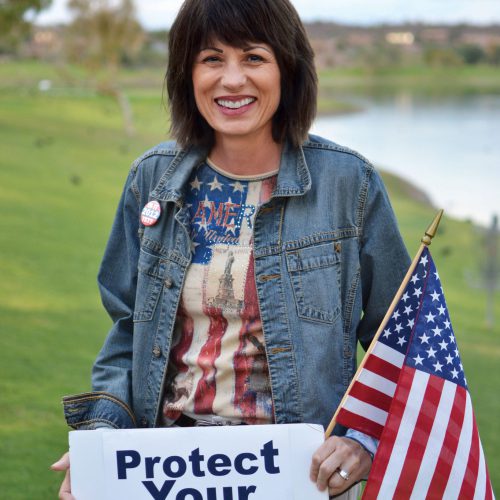
Dina Galassini of Fountain Hills, Ariz., found this out the hard way. In early October of 2011, she sent an email to 23 friends and neighbors asking them to join her in opposing a local bond issue. Dina thought that the bond issue was a bad deal for town residents that would only put the Town further into debt and would make a tax increase inevitable. She asked her friends to write letters to the editor and to forward her email to anyone they thought might benefit from it.
Then Dina asked them to join her in two protests. She thought gathering together with friends and neighbors on a street corner and waving signs would be an effective way to get her message out about the bond issue. It was a good plan, except for one thing: Under Arizona law, you need more than an opinion to join with others to speak about politics . . . you also need a lawyer.
Within a week after sending out her email, Dina received a letter from the town clerk urging her to “cease any campaign related activities” until she had registered as a “political committee” under Arizona law and complied with “all of the requirements associated with a PAC.” According to the clerk, although an individual acting alone is not a political committee, “if any additional person or persons join the effort” they must register as a PAC “prior to any electioneering taking place.”
Under Arizona law, if any two people worked together to talk about an election they had to register with the government before distributing any literature, making signs, passing out flyers, or even just sending an email, no matter how little they “spent.” Indeed, even if they never raised funds from others, the fact that their speech has value was enough to qualify them as a PAC. Under the law, they had to appoint a treasurer and chairman; designate a bank account; put notices on their signs, flyers, and emails stating that they were “paid for” by a PAC; track their activities and be prepared to open their files to the town; and file yet more paperwork with the government once the election was over.
Dina was stunned. She never thought the simple act of joining with others to voice her opposition to a local bond issue could land her in legal hot water. She cancelled her protests and began speaking to attorneys.
The Institute for Justice filed suit against the town for violating Dina’s First Amendment rights. Thanks to a ruling from the court, Dina was able to hold a protest two days before the end of voting. Not everyone is lucky enough to get free legal representation so quickly, however, and Dina pressed forward in her case for a ruling that will free up all Arizonans from burdensome campaign finance laws.
Dina’s case forced Arizona to change its laws. But demonstrating just how complicated these laws are, the new legislation failed to fix the many problems with the law.
In 2013, the court again struck down Arizona’s campaign finance scheme. The court held that Arizona’s definition of “political committee,” under which Dina was regulated, was vague, overbroad, and unduly burdensome. Describing the law, the judge noted that “it is not clear that even a campaign finance attorney would be able to ascertain how to interpret [it]” and that “[s]uch vagueness is not permitted by the Constitution.” Further noting the “heavy hand of government regulation,” the judge went on to hold that the “practical effect of [campaign finance] regulations for small groups makes engaging in protected speech a ‘severely demanding task.’”
The ruling was finalized in 2014. While the case was on appeal to the Ninth Circuit, the Arizona Legislature again amended Arizona’s campaign-finance laws; this time completely exempting speech like Dina’s from the regulatory scheme. This brought the case to an official end and now, every Arizonan can do something as simple as send an email to their friends and neighbors about issues important to them without having to worry about the heavy hand of the government silencing them. Chalk up another victory for free speech.
Case Team
Clients


Staff
John E. Kramer
Vice President for Strategic Relations
J. Justin Wilson
Vice President for Communications

Gretchen Embrey
Director of Paralegal Services & Senior Paralegal
Case Documents
Complaint
Motion: Temporary Restraining Order
Order: Granting Preliminary Injunction
Order: Ruling on the Motions
Declaratory Judgment
Media Resources
Get in touch with the media contact and take a look at the image resources for the case.
John E. Kramer Vice President for Strategic Relations [email protected] J. Justin Wilson Vice President for Communications [email protected]Related News
Press Release
IJ Scores Two Major First Amendment Victories
Press Release
Arizona Citizens Allowed to Speak Before Election
Related Cases

Commercial Speech | Economic Liberty | First Amendment | Sign Codes
Institute for Justice joins lawsuit defending family bar threatened with fines and even jail time for using “barbershop” theme to honor owners’ late father
Institute for Justice joins lawsuit defending family bar threatened with fines and even jail time for using “barber shop” theme to honor owners’ late father When Mike DiGiacomo and his siblings wanted…

Commercial Speech | First Amendment
Equine Body Work Teachers Sue Wisconsin for Violation of First Amendment Right to Occupational Speech
Jim Masterson has been working with animals for almost 30 years. But Wisconsin said he can’t teach without subjecting Jim’s school to an all-encompassing review of everything from Jim’s curriculum to intrusive inquiries into his…

First Amendment | First Amendment Retaliation
Arizona Educator Sues County Attorney Whose Hired Thugs Bullied Him Out of Election Campaign
Fernie Madrid ran for school superintendent in Apache, but he was running against the wife of the County Attorney, Michael Whiting. Whiting used his employees to retaliate against Fernie and bully him out of the…